Hazard survey and design review
Define whether the protection objective is fire control, extinguishment or exposure protection, using the actual hazard and accepted design basis.

Engineered valve-controlled fire and exposure protection
Hazard surveys, valve and nozzle selection, hydraulic coordination, detection interfaces, installation, commissioning and maintenance support for industrial and infrastructure projects across India.
A deluge system uses open sprinklers or spray nozzles supplied through a control valve. When the approved release arrangement operates, water enters the connected pipework and discharges through the open outlets in that zone.
Deluge arrangements can support fire control, cooling or exposure protection where a hazard requires coordinated water delivery. Selection must consider the protected material, geometry, process, water compatibility and available supply.
Reliance Fire Protection Systems supports surveys, engineering coordination, supply, installation, testing, commissioning and maintenance enquiries from Mumbai for project locations across India.
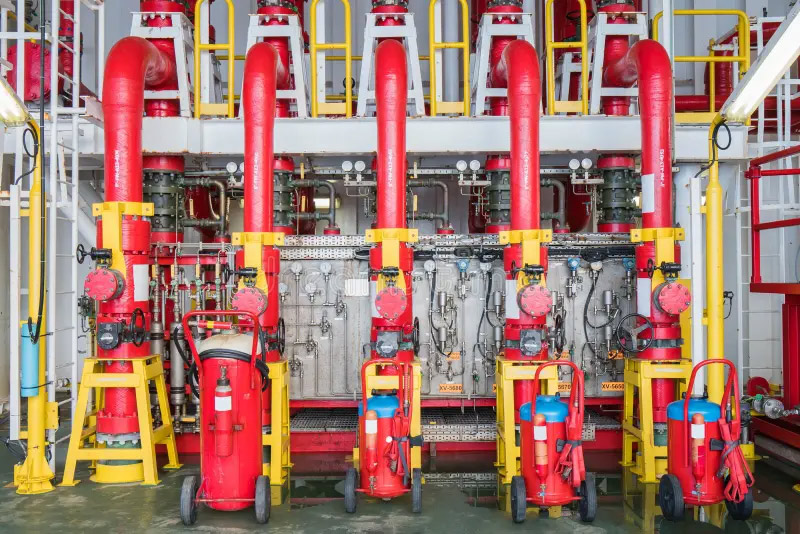
Application image for reference; the final valve, nozzles and protection layout are selected for the actual hazard.
Define whether the protection objective is fire control, extinguishment or exposure protection, using the actual hazard and accepted design basis.
Coordinate valve size, trim, isolation, gauges, alarms, test connections, drains and manual controls for the selected operating arrangement.
Review pipe routes, supports, nozzle type, spray geometry, obstructions and hydraulic demand for the protected zone.
Select compatible detection and releasing controls, alarm and fault signals and required plant interfaces with a documented sequence.
Install the agreed system and complete flushing, inspection, functional checks and specified water-discharge or acceptance tests.
Plan valve and release tests, supply checks, nozzle inspection, obstruction review and service records under the approved maintenance scope.
| Hazard or area | Protection objective | What to assess |
|---|---|---|
| Transformers and electrical plant | Suitable water-spray cooling or fire-control arrangement | Oil hazard, isolation, coverage, drainage and approved installation criteria |
| Industrial processes and equipment | Protection for defined equipment or exposure zones | Fuel, process conditions, geometry, shutdown interfaces and water compatibility |
| Conveyors and material handling | Targeted protection where the hazard review supports it | Belt and material hazards, drives, dust, obstructions and access |
| Storage and external exposures | Purpose-designed water or foam-water arrangement where appropriate | Agent suitability, containment, water supply and environmental conditions |
The compatible detection, pilot or manual input operates according to the approved release arrangement.
The selected valve and trim admit the supply to the connected protection zone.
The open sprinklers or nozzles discharge with the required pressure, flow and coverage.
Site personnel manage the incident and restore the system under the equipment instructions and agreed procedures.
NFPA 15 addresses fixed water-spray fire protection, while NFPA 25 addresses inspection, testing and maintenance of water-based systems. Confirm the applicable design basis and edition for the project.
The manufacturer's TYCO deluge valve documentation illustrates why the release method and trim must be selected together. Use the exact equipment instructions and approval scope rather than generalising one valve's features to every system.
Coordinate Indian statutory requirements, local authority conditions, water supply, drainage and any required process or electrical interfaces. Standards references do not establish certification of every installation.
Project enquiries are coordinated from Mumbai for industrial plants, power facilities, warehouses, manufacturing sites, process equipment and other suitable hazards. Equipment and site support depend on the location and agreed scope.
A deluge system uses open sprinklers or spray nozzles supplied through a control valve. When the approved release arrangement operates, water enters the connected pipework and discharges through the open outlets in that zone.
In a typical wet-pipe system, individual closed sprinklers open when their heat-sensitive elements operate. A deluge arrangement uses open outlets and a separate release arrangement, so water is delivered through the connected outlets when its valve opens.
Deluge or fixed water-spray arrangements may be assessed for transformers, industrial process equipment, conveyors, selected storage or exposure hazards and other applications requiring coordinated water discharge. Suitability depends on the hazard, agent, geometry and approved design.
The selected valve and trim may use electric, wet-pilot, dry-pilot or another supported release arrangement, with manual controls where specified. The detection, releasing equipment, monitoring and reset procedure must be compatible with the exact valve configuration.
No. Some projects use water, while others may require a suitable foam-water or other purpose-designed arrangement. Agent selection, proportioning, discharge devices and approvals depend on the hazard; systems are not interchangeable.
The design uses hazard geometry, required coverage, nozzle data, operating pressure, flow, duration, obstructions and hydraulic losses. Pumps, storage, simultaneous demands and drainage must be reviewed. One standard spacing or pipe size is not suitable for every project.
No. Deluge describes a valve-controlled discharge arrangement. Water curtains and water mist describe particular applications or discharge technologies with their own criteria. A project may combine terms, but the actual tested or approved design defines performance.
Suitable releasing controls and monitored interfaces can be coordinated with the fire alarm and plant systems. Confirm compatible devices, required signals, power arrangements, supervision and the documented cause-and-effect sequence.
Follow the approved design, manufacturer manuals and applicable requirements. The scope may include valve operation, release controls, alarms, water supply, nozzles, pipework, obstructions, corrosion and drainage. Plan discharge tests and system impairments with the site team.
Reliance Fire Protection Systems supports deluge project enquiries from Mumbai for sites across Indian states and union territories. Survey, engineering coordination, supply, installation, commissioning and maintenance scope depend on the hazard and project location.
Share the site location, hazard and process details, protected equipment or area drawings, water supply and pump information, existing systems, preferred release arrangement, drainage details and required approval basis.
Share the site location, hazard and process details, protected equipment or area drawings, water supply and pump information, existing systems, preferred release arrangement, drainage details and required approval basis.
Call +91 96999 90424 | sales@relifire.com | Contact Reliance Fire Protection Systems